


What if finding love didn’t require spending hours on every first date?
Microdating is gaining attention because it fits how people actually live now. Faster schedules, dating burnout, and shorter attention spans have all changed how we connect.
Instead of long, high-pressure dates, more people are choosing smaller, intentional moments to see if there’s real compatibility.
Dating is shifting. It’s less about big romantic gestures at the start and more about low-pressure connection that can grow over time.
Busy lives play a big role here. Work demands, personal responsibilities, and emotional fatigue from modern dating make long dates feel overwhelming. At the same time, expectations have changed. People want clarity faster, without wasting energy on something that doesn’t feel right.
But microdating isn’t about caring less. It’s about being more intentional with time, attention, and emotional energy.
What you’ll learn:
- What microdating means in modern relationships
- Why short dates are becoming more common
- The benefits and challenges of this dating style
- How to know if it fits the way you date
What Is Microdating?
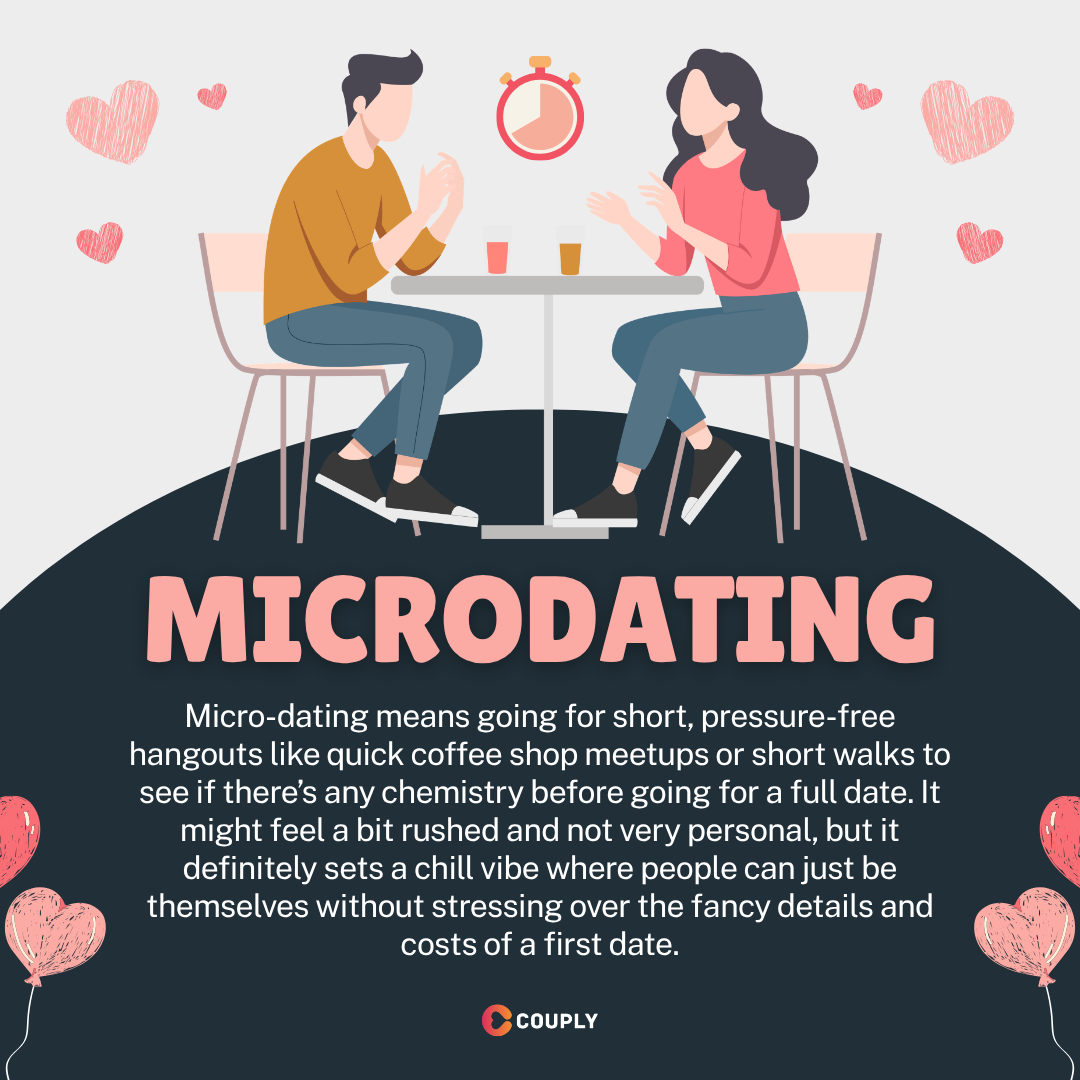
Microdating is a modern dating approach built around short, intentional interactions that help people explore connection without the pressure of a full-length traditional date.
Instead of investing several hours or an entire evening, microdates focus on smaller moments that still allow real interaction to happen.
The goal isn’t to rush connection. It’s to make dating more natural, low-pressure, and easier to fit into everyday life.
Microdating is about quality over quantity. A short experience can reveal just as much about compatibility as a long one, especially when repeated over time.
What Microdates Look Like
Microdates can be simple, casual, and easy to fit into a busy schedule. They’re not about impressing someone with effort or planning something elaborate.
Instead, they focus on real interaction in small windows of time.
Common examples include:
- A 20-minute coffee meet-up between errands or work
- A quick walk after work or class
- Sharing a short meal together instead of a full dinner date
- Grabbing drinks or snacks without committing to a long evening
- Doing a small activity like browsing a bookstore or market
The structure is flexible, but the intention is the same: create space for connection without pressure.
Microdating vs Traditional Dating
Traditional dating often involves longer time commitments, such as full dinners, extended outings, or planned activities that last several hours.
Microdating takes a different approach.
Traditional dating:
- Longer time investment
- Higher expectations for the experience
- More pressure to “make the night count”
Microdating:
- Short, flexible interactions
- Lower pressure environment
- Easier to repeat and build familiarity over time
Instead of trying to figure everything out in one long date, microdating allows connection to develop in smaller, more natural steps.
Why People Are Choosing Microdating
Dating burnout and emotional exhaustion
Many people feel tired from long dating cycles that don’t lead anywhere. Microdating reduces that emotional weight by keeping things light and manageable.
Busy lifestyles and limited time
Modern schedules don’t always allow for long dates. Microdating fits into real life instead of disrupting it.
A shift toward intentional connection
People are becoming more selective with their time. Shorter dates help them focus on how someone actually feels to be around, not just how the date looks on paper.
The Psychology Behind Microdating
Microdating works because it changes how connection is experienced.
Short interactions reduce pressure, which can lead to more natural behavior. People are less likely to perform and more likely to show who they really are.
Over time, repeated short interactions also build familiarity. Instead of relying on one big impression, attraction develops through consistency and comfort.
In many ways, microdating slows emotional decisions while still keeping dating active and intentional.
Signs Microdating Might Work for You
Microdating isn’t for everyone. Some people prefer long, immersive dates where connection builds over hours. Others feel more comfortable with shorter, intentional meetups that take the pressure off.
If you’re wondering whether this style fits you, here are some clear signs.
You prefer slow-building connections
You don’t need instant chemistry or fast emotional intensity. You’re more comfortable letting things develop over time.
You likely:
- Like getting to know someone gradually
- Don’t rush emotional closeness
- Prefer observing consistency before deciding how you feel
For you, attraction grows through familiarity, not urgency.
You value consistency over intensity
Big sparks can feel exciting, but they don’t always feel stable.
You probably care more about:
- How someone shows up over time
- Whether their behavior stays steady
- Feeling emotionally safe, not emotionally overwhelmed
Intensity might catch your attention, but consistency is what builds trust.
You dislike high-pressure first dates
Long first dates can sometimes feel like too much too soon.
You may find that:
- Extended dinners feel draining
- You feel pressure to “perform” socially
- You prefer something light and low-stakes
Shorter dates help you relax and be yourself instead of trying to impress.
You prefer casual environments
You feel more comfortable when the setting is simple and natural.
That might look like:
- Coffee shops instead of formal dinners
- Walks instead of structured plans
- Short meetups instead of all-night outings
Casual settings make it easier to focus on connection instead of presentation.
You want to date more intentionally
You don’t want endless talking stages or emotionally exhausting cycles.
Instead, you focus on:
- Compatibility
- Shared values
- Emotional alignment
You’d rather know early if there’s potential than invest heavily without clarity.
You don’t want to invest heavily too early
You’re careful with your time and energy.
This can mean:
- Avoiding long emotional commitments too soon
- Preferring gradual emotional investment
- Not rushing into deep involvement before trust is built
Microdating lets you stay open without overcommitting.
You value quality over quantity
For you, connection matters more than duration.
Even a short interaction feels meaningful if:
- The conversation flows well
- You feel understood
- There’s mutual interest
One strong moment can matter more than hours spent together without real connection.
Microdating works best for people who want connection to feel intentional, not overwhelming. It’s not about dating less. It’s about noticing more in less time.
The Benefits of Microdating
Microdating is becoming popular because it fits modern relationships better. It removes pressure, adds clarity, and helps people connect without overcommitting too early.
Here’s why it works for so many people.
Less pressure, more clarity
Shorter dates naturally lower expectations. You’re not trying to “make the night perfect” or force deep connection in one sitting.
This makes it easier to:
- Decide if you want another date
- Notice how you actually feel around someone
- Avoid forcing chemistry that isn’t there
Clarity shows up faster when pressure goes down.
Less emotional investment too early
Microdating helps you stay grounded in the early stages.
Instead of getting attached after one long, intense date, you:
- Pace your emotions
- Observe consistency over time
- Avoid overthinking early interactions
It creates space to understand someone before getting deeply invested.
More opportunities to meet people
Shorter dates are easier to fit into real life.
This means:
- Less scheduling stress
- Easier to say yes to meeting someone
- More flexibility in your dating life
Dating becomes something you can actually maintain, not something that drains your time and energy.
Better boundaries
Microdating naturally encourages healthier emotional limits.
It helps you:
- Protect your time
- Protect your emotional energy
- Avoid overattachment before trust is built
You stay more aware of what you’re giving and receiving early on.
Seeing consistency over time
Instead of relying on one long first impression, microdating gives you repeated, smaller moments to observe patterns.
This makes it easier to notice:
- Whether someone is consistent
- How they treat you over time
- Whether their actions match their words
Actions become clearer when they’re seen in multiple small interactions instead of one big event.
Microdating works because it slows down emotional assumptions while keeping connection active. It helps you see people more clearly, one small moment at a time.
The Potential Downsides of Microdating
Microdating can make dating feel easier and more flexible, but it also comes with trade-offs. When taken too far or used without awareness, it can limit emotional depth and connection.
Here are the main downsides to be aware of.
Mistaking convenience for connection
Short, easy meetups can feel good because they fit into your life without stress. But convenience doesn’t always mean compatibility.
Sometimes:
- You enjoy how easy it is to meet
- You confuse “smooth logistics” with real connection
- You overlook whether there’s emotional depth
A simple date can feel right without actually revealing much about long-term potential.
Short dates may stay surface-level
Microdates are designed to be quick, which means conversations often stay light.
This can lead to:
- Limited emotional sharing
- Less time to explore deeper values
- Connections that feel real but not fully understood
Without longer moments together, some layers of a person may never fully show up.
Less time can limit emotional depth
Emotional intimacy usually takes time to build. When interactions are always short, depth can develop more slowly.
You might notice:
- Fewer vulnerable conversations
- Less space for emotional unfolding
- A slower path to real closeness
Connection can still happen, but it may require more intentional effort over time.
Avoiding vulnerability
Microdating can sometimes become a way to stay emotionally safe.
It becomes a problem when:
- Everything stays casual indefinitely
- Deeper conversations never happen
- Emotional risks are consistently avoided
At some point, connection needs openness to grow.
Never moving beyond the “getting to know you” stage
Short interactions can unintentionally keep relationships stuck in early-stage energy.
This looks like:
- Constant first-date feelings
- No progression into deeper connection
- Repeated small talk instead of meaningful intimacy
Without moving forward, relationships can stall emotionally.
Treating dating like a checklist
Microdating can sometimes make it easier to evaluate people quickly, but that can turn into over-filtering.
This can lead to:
- Judging too fast based on first impressions
- Overlooking deeper qualities
- Reducing people to quick yes/no decisions
Some compatibility only shows up with time.
Creating emotional distance
When caution becomes the default, it can block closeness.
Too much distance may look like:
- Holding back emotions constantly
- Avoiding deeper connection to stay “safe”
- Struggling to fully invest in someone
Protection can turn into disconnection if it’s not balanced with openness.
Microdating works best when it creates space for connection, not when it replaces deeper emotional investment. The goal is balance, not avoidance.
Microdating vs Slow Dating: What’s the Difference?
Microdating and slow dating both react to the same problem: modern dating moves too fast and often feels overwhelming. But they solve it in different ways.
One uses short, intentional moments. The other uses patience and pacing. Both aim for better connection, just through different rhythms.
Microdating focuses on:
Short interactions
Instead of long, drawn-out first dates, microdating uses quick meetups to see if there’s a spark without heavy time investment.
Low-pressure connection
The goal is to reduce stress. You’re not trying to figure everything out in one sitting, just seeing how it feels to be around someone.
Testing compatibility
Microdating helps you observe small signals early, like communication style, comfort level, and basic chemistry.
It’s about gathering small data points through real-life interaction.
Slow dating focuses on:
Taking time
Slow dating spreads connection out over time instead of rushing into emotional intensity or quick decisions.
Avoiding rushed decisions
You don’t jump to conclusions early. You let feelings develop naturally before labeling the relationship.
Letting connection naturally develop
Instead of structuring dating around efficiency, slow dating allows space for emotions, trust, and attachment to build gradually.
It’s less about speed and more about depth over time.
How they overlap
Even though they look different, microdating and slow dating share important similarities.
Both prioritize intention
Neither approach is about random or careless dating. Both encourage being mindful about who you spend time with.
Both challenge fast-paced dating culture
They push back against burnout, endless talking stages, and rushed emotional decisions.
Both value meaningful connection over instant results
Whether it happens quickly in short moments or slowly over time, the goal is the same: real connection, not surface-level dating.
Microdating changes the format of dating, while slow dating changes the pace. Both are trying to make modern love feel more intentional, just in different ways.
How to Make Microdating Actually Work
Microdating can be a great way to make dating feel lighter and more intentional, but it works best when it’s paired with honesty and emotional awareness.
Short dates shouldn’t be a way to avoid connection. They should create space for connection to grow naturally.
Here’s how to make microdating work for you.
Be clear about your intentions
Before you start microdating, know what you’re hoping to find.
Ask yourself:
- Am I looking for something casual or serious?
- Do I want to explore a connection slowly?
- What kind of relationship am I open to?
Being clear doesn’t mean putting pressure on every interaction. It simply helps you avoid mismatched expectations.
It also helps to communicate your intentions early. You don’t need a serious relationship talk on the first date, but being honest about what you’re looking for creates a healthier foundation.
Don’t judge everything too quickly
Microdates are short, which makes first impressions feel even more important.
But one conversation doesn’t always tell the whole story.
Someone might:
- Feel nervous at first
- Take time to open up
- Need more than one interaction to show their personality
Give people room to unfold.
A lack of instant fireworks doesn’t always mean there’s no potential.
Focus on how you feel around them
Instead of only asking, “Do I like them?” pay attention to how the interaction feels.
Ask yourself:
Do I feel comfortable?
Can I relax and be myself around them?
Do I feel respected?
Do they listen, show effort, and consider my feelings?
Am I curious to know more?
Do I genuinely want another conversation?
Sometimes connection isn’t about a dramatic spark. Sometimes it’s about feeling safe enough to keep exploring.
Move beyond micro when connection grows
Microdating works best as a starting point, not a permanent stage.
When you notice potential, allow the relationship to deepen through:
Deeper conversations
Move beyond surface-level topics and learn about each other’s values, experiences, and needs.
Longer experiences
Spend more time together in different situations and see how your connection develops.
More emotional openness
Let trust build through honesty and vulnerability.
A relationship can start small without staying small.
Microdating isn’t about keeping people at a distance. It’s about creating space to notice the right things before investing deeper. The goal is not less connection, but more intentional connection.
The Future of Dating: Are Smaller Dates Becoming More Meaningful?
Dating is changing.
For a long time, dating was often associated with big plans, long conversations, and trying to create a memorable first impression. But as people become more aware of their time, emotional energy, and relationship needs, many are starting to value something different.
Instead of asking, “How do I make this date impressive?” more people are asking, “Does this connection feel genuine?”
That’s where microdating comes in.
Why modern dating is changing
People want less pressure
Modern dating can feel exhausting. Between endless apps, conversations that go nowhere, and repeated first dates, many people are looking for a way to connect without feeling overwhelmed.
Smaller dates create room to explore someone without the pressure of making every interaction feel like a major romantic moment.
A quick coffee or short walk can reveal a lot:
- Do conversations flow?
- Do you feel comfortable?
- Do you actually want to see them again?
Sometimes less pressure makes it easier to be yourself.
Emotional energy feels more valuable
People are becoming more intentional about where they put their time and emotions.
A long date requires more investment. When there’s no connection, it can feel draining.
Microdating allows people to:
- Protect their emotional energy
- Stay open without overcommitting
- Learn about someone gradually
It creates a healthier pace where curiosity can exist without immediate attachment.
Many are choosing intentional connection over endless searching
Dating culture has often focused on finding the “perfect match” quickly.
But microdating shifts the focus.
Instead of constantly searching for the next option, it encourages people to slow down and pay attention to real interactions.
The goal isn’t to meet more people just for the sake of meeting more people.
It’s to notice who actually creates a meaningful connection.
Small Moments Can Create Big Connections
A relationship doesn’t always begin with a perfect date.
Sometimes connection develops through ordinary moments:
- A short conversation that feels easy
- A small gesture that shows thoughtfulness
- A simple interaction where you feel seen
Chemistry isn’t always found in grand romantic settings.
Sometimes it appears in the quiet moments where two people are simply comfortable being themselves.
Microdating reflects how relationships are changing.
It focuses on:
- Short but meaningful interactions
- More intentional dating habits
- Building connection without unnecessary pressure
But the point isn’t to keep dates small forever.
The point is to create space where you can notice what actually matters.
Dating doesn’t have to be exhausting to be meaningful.
A relationship isn’t built by spending the most time together. It’s built by paying attention to whether the time you spend together creates trust, curiosity, and genuine connection.
The best connections aren’t always found through perfect dates. They’re often built through small moments that reveal who someone really is.
Ask yourself: “Am I dating to find a perfect moment, or am I paying attention to the small moments that reveal who someone really is?”