


In today’s dating culture, saying you’re “dating multiple people” can instantly earn you the label toxic, emotionally unavailable, or a walking red flag. For many, the phrase alone triggers alarm bells.
Modern dating often confuses clarity with commitment. We’ve been taught that emotional safety comes from early exclusivity, quick labels, and intense focus on one person. Anything slower—or more spacious—can feel threatening, even when it’s healthy.
Stack dating brings up very real emotional reactions: jealousy, fear of being replaced, anxiety about not being “chosen,” or memories of past relationships where transparency was missing. For people with relationship trauma or anxious attachment, it can feel like a replay of abandonment—even when no harm is happening.
Stack dating isn’t about keeping options open or avoiding intimacy. At its healthiest, it’s about slowing down, observing behavior over time, and choosing intentionally rather than reactively. It’s a strategy for dating smarter, not colder.
What Stack Dating Actually Is (And Isn’t)
.png)
"Stack dating" means dating more than one person casually and honestly, without rushing into exclusivity before you have enough information to decide.
This includes:
- Being upfront that you’re not exclusive yet
- Avoiding misleading language like “you’re the only one I’m seeing” if that’s not true
- Allowing each connection to develop naturally without comparison or competition
What it is not:
- Lying by omission
- Hiding other connections
- Creating emotional dependency while withholding clarity
Stack dating prioritizes observation over intensity.
Instead of asking:
- “Do I feel a spark?”
It asks: - “How do I feel around this person over time?”
- “Do their actions match their words?”
- “How do they handle stress, boundaries, and disagreement?”
This approach allows consistency to reveal compatibility—something that early chemistry alone can’t do.
Many people rush exclusivity to soothe anxiety, not because trust has actually been built. Stack dating can interrupt this pattern by encouraging emotional regulation instead of urgency.
Healthy stack dating relies on clear boundaries, not ambiguity.
Key boundaries include:
- Clarity about exclusivity status
- Emotional honesty without oversharing prematurely
- Respect for each person’s autonomy
This is where stack dating often gets misunderstood. When done poorly, it looks like breadcrumbing or benching. When done well, it looks like grounded dating with integrity.
Stack dating vs. unhealthy behaviors:
- Breadcrumbing: giving just enough attention to keep someone hooked
- Ghosting: disappearing instead of communicating
- Benching: keeping someone “on hold” for validation
Stack dating avoids all three by emphasizing communication and mutual choice.
Why This Distinction Matters
From a therapeutic perspective, stack dating can be a corrective experience—especially for people who:
- Tend to overattach quickly
- Have a history of choosing emotionally unavailable partners
- Confuse intensity with intimacy
When practiced consciously, stack dating teaches patience, self-trust, and discernment. It shifts dating from “How do I get chosen?” to “Is this relationship actually healthy for me?”
And that question—while uncomfortable—is one of the smartest ones you can ask.
Why Stack Dating Feels “Toxic” at First
We’re Conditioned to Attach Quickly
Most people are taught that romantic success looks like immediate focus, fast exclusivity, and emotional intensity early on. Movies, social media, and dating advice often frame instant sparks as proof of compatibility. When that intensity is missing, people assume something is wrong.
The problem is that intensity is not the same as intimacy. Intensity is fast and emotionally charged. Intimacy is built through consistency, safety, and time. Stack dating challenges this conditioning by slowing the process down, which can feel unsettling if you are used to equating speed with seriousness.
When exclusivity is delayed, some people interpret it as disinterest, emotional unavailability, or fear of commitment. In reality, it may simply reflect a desire to choose deliberately rather than impulsively.
Attachment Styles and Emotional Triggers
Stack dating often activates attachment patterns, especially for people who have experienced inconsistency or abandonment in past relationships.
For those with anxious attachment, stack dating can trigger fears of being replaced, not being enough, or losing emotional security. The nervous system may respond with hypervigilance, reassurance-seeking, or urges to lock the relationship down quickly.
For those with avoidant attachment, stack dating can be misused as a shield. Instead of intentional pacing, it becomes a way to keep emotional distance, avoid vulnerability, or resist deeper connection altogether. This is where the concept can be applied unhealthily.
The key distinction is motivation. Healthy stack dating is driven by discernment and self-awareness. Unhealthy use is driven by fear, avoidance, or the need for control.
Discomfort Doesn’t Mean Dysfunction
Feeling uncomfortable while stack dating does not automatically mean something is wrong. Emotional growth often includes uncertainty, delayed gratification, and learning to tolerate ambiguity.
Discomfort becomes a red flag only when it is paired with confusion, secrecy, or lack of care for another person’s emotional experience. Growth-related discomfort feels challenging but grounded. Dysfunctional discomfort feels destabilizing and unsafe.
A helpful reflection is to ask whether the discomfort is coming from unhealed attachment wounds or from actual boundary violations. Stack dating can surface emotional patterns that are worth paying attention to, not signs that the process itself is unhealthy.
In many cases, the discomfort is not a signal to stop dating this way. It is an invitation to slow down, regulate emotions, and make choices from clarity rather than fear.
Stack Dating vs. Playing Games (Key Differences)
Stack dating can look confusing at first because it shares some surface similarities with manipulative dating behaviors. The key difference lies in intention, honesty, and respect.
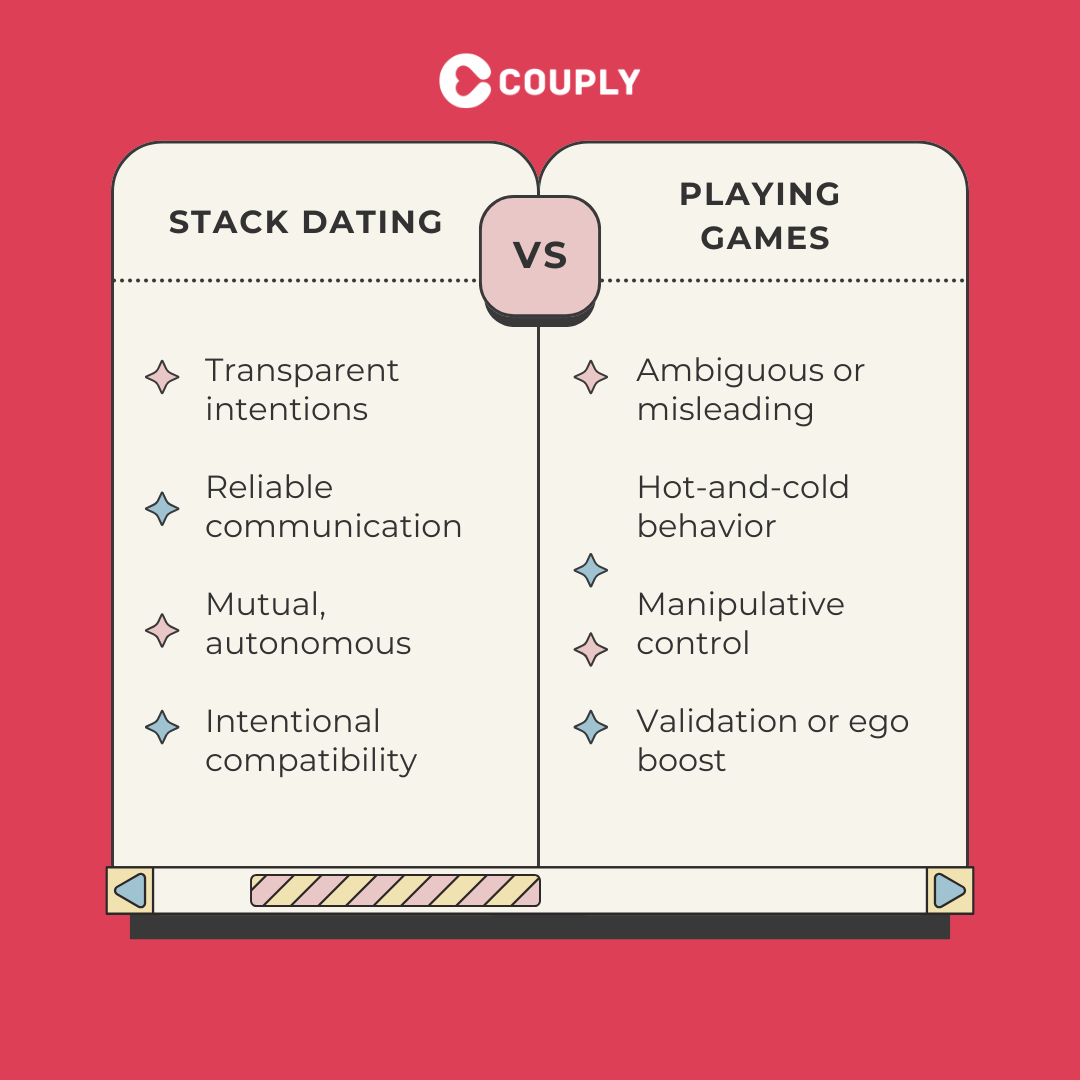
Honesty vs. Ambiguity
In stack dating, transparency is essential. Everyone knows that exclusivity is not immediate, and expectations are set upfront. Playing games, on the other hand, relies on mixed signals, secrecy, or misleading promises to manipulate feelings.
Consistency vs. Hot-and-Cold Behavior
Healthy stack dating involves steady, reliable communication. You know where you stand, even if exclusivity is delayed. Manipulative games often create emotional turbulence, giving attention one moment and disappearing the next.
Mutual Choice vs. Emotional Control
Stack dating respects everyone’s autonomy. Both parties can make informed decisions without coercion. Games tend to control emotions through jealousy, scarcity, or emotional pressure.
Dating With Intention vs. Dating for Validation
The goal of stack dating is intentional: to explore patterns, observe compatibility, and make informed relationship choices. Playing games is often ego-driven, used to boost self-esteem at the expense of another person’s emotional safety.
Who Stack Dating Works Best For (And Who Should Be Careful)
Stack dating is not a universal solution, and it is not meant to override self-awareness. Like any dating approach, its impact depends on emotional maturity, communication skills, and intention.
When Stack Dating Is Healthy
Stack dating works best for emotionally self-aware daters who understand their own patterns and triggers. These are people who can notice attraction without immediately attaching, and who are able to communicate honestly without overpromising.
It is especially helpful for individuals healing from rushed or unhealthy relationships. When someone has a history of committing too quickly or overlooking red flags, stack dating creates space to slow down, observe behavior over time, and make decisions based on consistency rather than intensity.
Stack dating also supports people who are genuinely seeking long-term compatibility. By dating intentionally and without premature exclusivity, individuals can compare values, communication styles, and emotional availability before committing, rather than hoping chemistry alone will carry the relationship.
When Stack Dating Can Become Harmful
Stack dating becomes harmful when it is used to avoid vulnerability. If someone keeps multiple connections purely to prevent emotional closeness or to escape accountability, the structure becomes a defense mechanism rather than a healthy dating strategy.
It can also turn unhealthy when clarity is withheld. Avoiding conversations about expectations, timelines, or emotional boundaries creates confusion and emotional imbalance, even if exclusivity has not been agreed upon.
Finally, stack dating crosses into harm when people are kept “just in case.” When partners are treated as backups rather than autonomous individuals with agency, the approach shifts from intentional dating to emotional insurance, which erodes trust and self-worth.
How to Stack Date in a Healthy Way
Healthy stack dating is not passive and it is not vague. It requires clarity, emotional regulation, and ongoing self-check-ins. The goal is not to keep options open indefinitely, but to create enough space for real patterns to emerge before committing.
Set Clear Expectations Early
From the beginning, it is important to name what kind of dating you are practicing. This does not mean sharing every detail about other dates, but it does mean being honest about non-exclusivity. Clear expectations protect everyone involved from confusion and false assumptions. When people know where they stand, they can consent emotionally instead of guessing or filling in gaps with anxiety.
Limit Emotional Over-Investment Too Soon
Stack dating works best when emotional pacing matches the stage of the connection. This means enjoying dates, conversation, and chemistry without immediately prioritizing one person as if a commitment already exists. Over-investing early can recreate the same rushed dynamics stack dating is meant to prevent. Slowing emotional attachment allows you to stay grounded and make decisions based on reality rather than fantasy.
Observe Actions Over Words
One of the strengths of stack dating is that it gives time for behavior to speak. Consistency, follow-through, and emotional availability show up over weeks, not a single date or text exchange. Promises, charm, or intense interest can feel convincing early on, but patterns reveal compatibility. Watching actions over time helps separate genuine alignment from temporary excitement.
Know When to Transition to Exclusivity
Stack dating is not meant to last forever. A healthy transition to exclusivity happens when interest becomes mutual, consistent, and emotionally safe. Signs include wanting to deepen trust, feeling secure rather than anxious, and noticing that other connections naturally fade without forcing distance. Choosing exclusivity should feel like a grounded decision, not a fear-based one.
What Stack Dating Teaches You About Yourself
One of the most overlooked benefits of stack dating is how much self-awareness it builds. When you remove urgency and exclusivity from the early stages, you begin to notice your internal reactions more clearly. These reactions offer valuable information about your emotional patterns, needs, and attachment style.
Emotional Regulation
Stack dating often brings up feelings like uncertainty, jealousy, or the urge to secure reassurance. Learning to sit with these emotions instead of acting on them impulsively strengthens emotional regulation. Rather than seeking immediate validation from one person, you practice soothing yourself, staying grounded, and responding thoughtfully. This skill is essential for healthy long-term relationships, not just dating.
Boundary-Setting
Dating multiple people ethically requires clarity about what you can and cannot offer. You learn how to state boundaries early, whether around time, communication, or emotional availability. This process builds confidence in saying no, asking for what you need, and respecting others’ limits as well. Boundaries stop feeling like rejection and start feeling like self-respect.
Attachment Awareness
Stack dating can gently expose attachment patterns that may otherwise stay hidden. Anxious attachment may show up as a strong desire to lock things down quickly. Avoidant attachment may appear as emotional distance disguised as independence. Recognizing these patterns gives you the opportunity to respond differently rather than repeating old dynamics unconsciously.
Choosing Based on Compatibility, Not Anxiety
When urgency is removed, decisions become clearer. You are no longer choosing someone because they feel familiar, intense, or calming to your anxiety. Instead, you start choosing based on values, consistency, communication, and emotional safety. Stack dating creates space for compatibility to matter more than chemistry alone.
Stack dating is often misunderstood because it challenges a dating culture built on speed, intensity, and instant certainty. The discomfort many people feel is not a sign that something is wrong. It is often a sign that old habits are being questioned.
Choosing to date slowly and intentionally is not avoidance or indecision. It is a response to rushed, chaotic dating patterns that leave people burned out and disconnected. Stack dating prioritizes clarity, emotional pacing, and informed choice.
You are allowed to take your time. You are allowed to observe, reflect, and decide without pressure. Healthy dating does not feel urgent or destabilizing. It feels grounded, honest, and aligned with who you are becoming.


