


You’ve been quiet for days. You tell yourself it’s because you need space, but deep down, you’re waiting for them to feel what you felt—ignored, small, maybe even guilty. It’s not malicious. You love them. But something in you wants them to get it.
Here’s the truth no one likes to admit: we all punish our partners in small, subtle ways sometimes. It’s not about being toxic or cruel. It’s about the human instinct to protect ourselves when we feel hurt, disappointed, or unseen.
The problem? Emotional punishment slowly chips away at connection. It’s like leaving tiny cracks in the walls of your relationship until one day, they become too deep to fix.
So let’s talk about it—because awareness is where change begins.
These are 10 subtle ways you might be punishing your partner without realizing it, and what to do instead if you want love that heals instead of hurts.
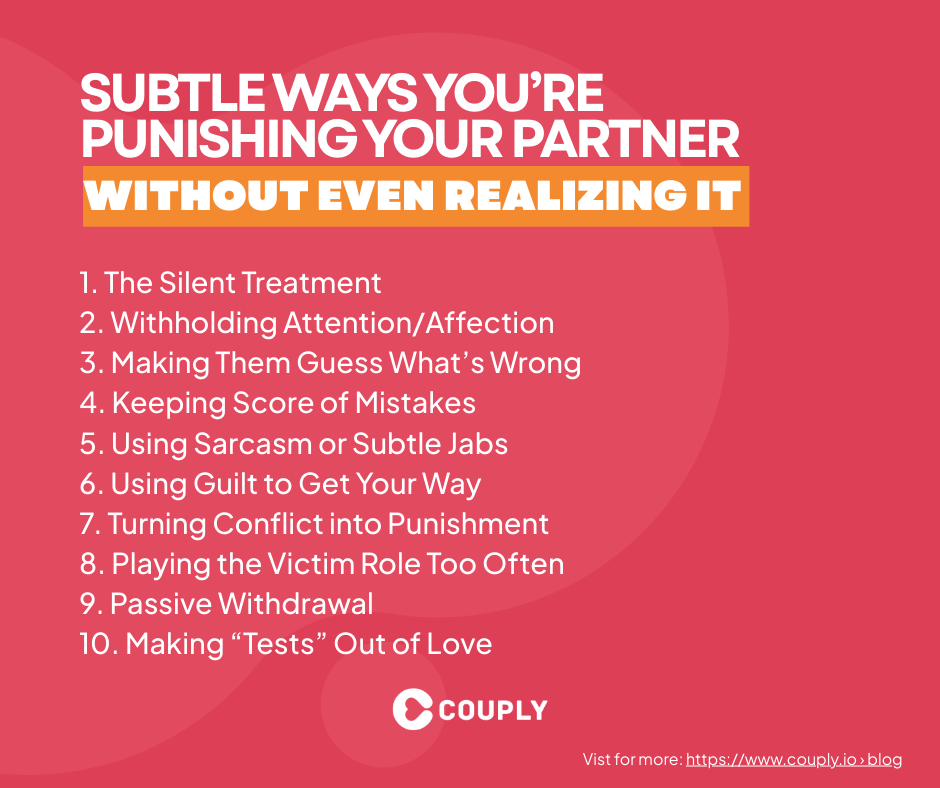
1. The Silent Treatment (Aka Emotional Timeout Disguised as Control)
So, here’s what I think. When you go quiet because you’re upset, it feels like you’re keeping the peace. But you won’t believe this… to your partner, it usually feels like you hit the mute button on the whole relationship. The room gets heavy. The vibe shifts. And suddenly they’re wondering if they did something terrible.
I once had an experience where a couple told me, “We don’t fight. We go silent instead.” And I was like… that’s not calm, that’s emotional freeze. Silence can feel like a locked door that says, “Figure this out without me.” Can you imagine how confusing that is?
The Silent Treatment doesn’t teach lessons. It teaches fear, pressure, and the feeling of being shut out.
What to try instead:
- Say something short and real like, “I need a little time to cool down. I’ll check back in soon.”
- Set a tiny timeframe. An hour. Two. Something that reassures your partner you’re still emotionally present.
- Let space soothe both of you instead of making anyone feel punished.
Anyway, communication doesn’t have to sound perfect. It just has to keep the door open. What do you think?
2. Withholding Affection or Attention
When you’re upset and you start pulling away—no hugs, no “goodnight,” turning your back in bed—it feels quiet on the outside but loud on the inside. You won’t believe this, but many people don’t even notice they’re doing it. It becomes this subtle way of saying, “You hurt me,” without actually saying it.
This reminds me of a time when someone told me, “I wasn’t trying to punish him. I was trying to protect myself.” And I get that. Emotional hurt makes us want to curl up like a snail. But withholding affection teaches your partner that love depends on behavior. Like they need to earn their way back into your arms. That’s heavy, right?
And let’s be real... affection is not a reward. It’s a shared need. It’s part of the glue that keeps the relationship warm even when the mood is weird.
What to try instead:
- Try something simple like, “I’m hurt right now, but I still care about you.”
- Keep small gestures alive. A gentle touch on the arm. A soft “goodnight.”
- Let affection stay steady even when emotions feel messy.
Oh, and healing grows in places where love feels safe. Not rationed. What do you think?
3. Making Them Guess What’s Wrong
When you say “Nothing” but your sighs are louder than a fire alarm, your partner knows something is off. And let’s be real... we’ve all done that thing where we hope they’ll magically read our mind. It feels romantic in theory. In real life, it’s like trying to juggle water. No one wins.
This reminds me of a time when someone told me, “If they really knew me, they’d know what I’m feeling.” And I thought, yeah, that sounds sweet, but also kind of impossible. Even the most attentive partner can’t decode hints all the time. When you make them guess, you’re setting up a test you didn’t even warn them about.
And anyway, emotional maturity is not about perfect phrasing. It’s about showing up with honesty instead of mystery.
What to try instead:
- Start with something small like, “Something you said earlier hurt me, and I’m still sorting through it.”
- Keep it simple. Keep it honest.
- Give them a chance to understand instead of making them play detective.
By the way, relationships grow faster when no one is guessing. Can you imagine how much lighter it feels when you both know what’s going on?
4. Keeping Score of Mistakes
You say you’ve forgiven them, but in the next argument, you bring it all back up. You keep mental tabs—how many times they forgot to text, how often they said the wrong thing.
Keeping score might feel like protecting yourself, but it turns love into a competition where nobody wins.
What to do instead:
- When you forgive, really release it.
- If something still feels unresolved, revisit it with the intent to understand, not attack.
- Remember, healing is teamwork, not tallying.
You can’t build trust while holding a scoreboard.
5. Using Sarcasm or Subtle Jabs
“I guess someone’s too busy for me again,” you say with a smirk.
“It must be nice to have no responsibilities,” you joke when they relax.
Sarcasm might seem harmless, but it often hides resentment. It’s like throwing small darts—you laugh, but the sting stays.
Emotionally intelligent communication avoids cruelty masked as humor. Sarcasm chips away at emotional safety faster than shouting ever could.
What to do instead:
- Speak directly. Say what you mean, not what you wish they’d guess.
- Replace sarcasm with vulnerability: “I felt unimportant when you canceled plans.”
- Choose clarity over cleverness.
Real connection happens when honesty feels safe.
6. Using Guilt to Get Your Way
“If you really loved me, you’d do it.”
“I always make sacrifices—you never do.”
“You don’t even care enough to try.”
Guilt is manipulation dressed up as vulnerability. It pushes your partner into compliance, not compassion.
And here’s the hard truth: someone who gives in out of guilt isn’t connecting with you—they’re managing you.
What to do instead:
- Replace guilt with accountability: “It would mean a lot to me if you could help with this.”
- Express needs without emotional leverage.
- Let love be a choice, not an obligation.
Guilt builds compliance; vulnerability builds intimacy.
7. Turning Conflict Into Punishment
You bring up an issue but don’t actually want to resolve it. You want them to feel the discomfort you felt.
Conflict becomes about balance—who hurts more, who wins the argument, who gets the last word. But real relationships aren’t justice systems. They’re collaborations.
What to do instead:
- Approach conflict like teammates, not opponents.
- Say, “I want to solve this, not win this.”
- Focus on the problem, not the punishment.
Healthy love doesn’t seek revenge; it seeks repair.
8. Playing the Victim Role Too Often
“I guess I’m always the problem.”
“You always make me feel like this.”
“I can’t do anything right.”
When you constantly position yourself as the helpless one, it forces your partner into a caretaker role—and that dynamic drains both of you.
Victimhood can feel safer than accountability. But over time, it suffocates growth and breeds resentment.
What to do instead:
- Acknowledge your pain and your power.
- Say, “That really hurt me, but I want to work through it with you.”
- Choose self-awareness over self-pity.
Empathy is healing. Self-pity keeps you stuck.
9. Passive Withdrawal (When You Shut Down Instead of Speaking Up)
You stop sharing updates. You respond with one-word answers. You shrink emotionally, hoping they’ll notice and chase.
Withdrawal often feels like the only way to feel in control when you’re hurt. But emotional distance rarely inspires closeness—it builds confusion and insecurity.
What to do instead:
- When you want to pull away, pause and name it: “I’m feeling disconnected right now.”
- Ask for reassurance instead of waiting for rescue.
- Vulnerability keeps the door open.
Love can’t reach where walls are built.
10. Making “Tests” Out of Love
You text less to see if they’ll notice.
You pretend to be fine just to see if they’ll ask again.
You set invisible tests—and feel crushed when they fail.
These emotional tests come from fear, not malice. You want proof of care. You want reassurance without having to ask. But those games breed insecurity, not intimacy.
What to do instead:
- Stop testing, start trusting.
- Ask for what you need—attention, affection, reassurance.
- Communication isn’t begging; it’s emotional honesty.
Real love doesn’t pass tests; it builds trust.
Why We Do It (Even When We Know It Hurts)
You know that feeling when you catch yourself doing the exact thing you swore you wouldn’t? You’re pulling away, being short, holding back affection—and even as you’re doing it, there’s a quiet voice in your head saying, “This isn’t helping.” But somehow, you still can’t stop.
That’s the tricky thing about emotional punishment: it’s not about wanting to hurt your partner. It’s about wanting to protect yourself.
When we feel misunderstood, dismissed, or unloved, our nervous system goes into defense mode. For some people, that means lashing out. For others, it means shutting down. It’s the emotional equivalent of crossing your arms and saying, “Fine, you can’t reach me now.”
And while it may feel like control in the moment, what’s really happening underneath is fear. Fear of rejection. Fear of losing power. Fear of being the one who loves more.
1. It’s How We Learned to Feel Safe
Many of us learned emotional protection from childhood, not through words but through behavior.
Maybe you grew up in a home where silence was the only way to survive conflict. Or maybe love was inconsistent—you never knew when affection might turn cold, so you learned to protect yourself by withdrawing first.
Those patterns don’t disappear when we fall in love. They follow us quietly, waiting for familiar triggers. Suddenly, you’re not just upset about your partner forgetting to text—you’re reliving every moment someone made you feel small, invisible, or unwanted.
So you pull away. You go cold. You punish, not out of malice, but memory.
2. We Mistake Control for Strength
When we feel hurt, we want the upper hand again. Silence, guilt, sarcasm—they all give the illusion of power. If you can make your partner feel bad or chase you, it means they care, right? It means you matter.
But what starts as control ends as distance. Emotional control says, “I’ll feel safe when you change.” Emotional maturity says, “I’ll feel safe when I can stay open, even when I’m scared.”
Control might make you feel powerful for a moment, but vulnerability is what actually builds connection.
3. We Fear Rejection More Than Loneliness
Sometimes punishing our partner feels safer than risking rejection. If you’re the one to pull away first, you can’t be the one left behind.
It’s a form of emotional preemption: I’ll hurt you a little now so you can’t hurt me later. It’s self-preservation disguised as strength. But in truth, it’s isolation. You end up protecting yourself from the very intimacy you crave.
You might say, “I’m fine,” when you’re not. You might turn cold when what you really need is closeness. All because closeness feels dangerous when you’ve been let down before.
4. We Confuse Love With Proof
Punishment often comes from a desperate need for reassurance. You want your partner to prove their love—to text first, to apologize first, to chase. You’re not trying to be cruel; you’re trying to confirm that you matter.
But healthy love isn’t proven through suffering. It’s built through safety. The kind that says, “I know you love me, even when we disagree.”
If you find yourself withholding or testing, it might be time to ask: What reassurance am I craving right now that I’m too afraid to ask for? Because beneath the punishment is usually a plea: See me. Choose me. Love me anyway.
5. We Don’t Know What to Do With Our Anger
Anger is a powerful emotion, and for many people—especially those who grew up in environments where it wasn’t safe to express it—it becomes redirected. Instead of saying, “I’m mad,” we go quiet. Instead of crying, we freeze.
That energy doesn’t vanish; it leaks out as sarcasm, coldness, or guilt-tripping. Punishment becomes the way we express what we don’t know how to articulate.
But anger, when handled consciously, can actually lead to healing. It’s your system saying, “Something doesn’t feel fair.” The goal isn’t to suppress it, but to guide it into communication, not control.
The bottom line: We punish because we’re scared. We withdraw because we’re wounded. We manipulate because we don’t yet know how to ask directly for what we need.
Recognizing these patterns isn’t about shame—it’s about liberation. Because the moment you notice, you create space to choose differently. You shift from reacting to relating. From defending to connecting.
Healing starts when you realize that punishment doesn’t bring peace—it delays it. And every time you choose understanding over control, your relationship grows safer, softer, and stronger than before.
How to Stop Punishing and Start Healing
Breaking these cycles takes intention, not perfection. Start small.
Here’s how to move toward emotional maturity and safer love:
1. Name what’s really going on.
Instead of saying “I’m fine,” say, “I’m hurt, and I don’t know how to express it yet.” Naming emotion takes away its power to control you.
2. Choose vulnerability over control.
Punishment is control in disguise. Replace control with curiosity—what would happen if I shared instead of withheld?
3. Check your emotional triggers.
Ask yourself, “Is my reaction about this moment or my past?” Most emotional punishment stems from old wounds replaying in new love.
4. Communicate needs without guilt or tests.
Say what you need clearly. “I need comfort right now,” is stronger and safer than silence or manipulation.
5. Learn emotional regulation skills.
Deep breathing, grounding, journaling—tools that help you respond instead of react. Emotional intelligence begins with self-soothing.
6. Seek professional help if needed.
Therapy isn’t about fixing a relationship; it’s about unlearning patterns that harm it. Sometimes love needs a witness to guide it back to safety.
When Love Feels Heavy—Pause, Don’t Punish
You’re allowed to need space. You’re allowed to feel angry, tired, or disappointed. But love doesn’t grow in silence or control—it grows in honesty and compassion.
Every time you resist the urge to punish, you choose connection over fear. You choose growth over pride. You choose partnership over power.
Because love isn’t about who hurts less. It’s about who chooses to heal more.
If you recognized yourself in any of these patterns, take a breath. You’re not the villain in your love story—you’re human. You learned to protect your heart the best way you knew how.
But now you know better. And with awareness, you can do better.
Start small. Speak when silence tempts you. Hold when you want to pull away. Soften when you want to win.
That’s how love becomes strong enough to survive the quiet punishments—because healing, after all, is the loudest kind of love there is.


