


"Why do I react so strongly to small things?"
"Why do I get jealous so easily?"
"Why do I panic when they don’t text back?"
“Why do I push people away when things start getting serious?”
“Why do I shut down instead of saying what I actually feel?”
“Why do I keep choosing partners who trigger the same wounds?”
“Why do I need constant reassurance, even in a healthy relationship?”
“Why does being loved sometimes make me anxious instead of calm?”
Do these phrases sound familiar? Do you hear it from your partner, or perhaps are these internal dialogues quite closer to your heart? Do not fret; everyone (yes, including me) has a past that we bring into a relationship. This is what we call "emotional baggage."
What Is Emotional Baggage?
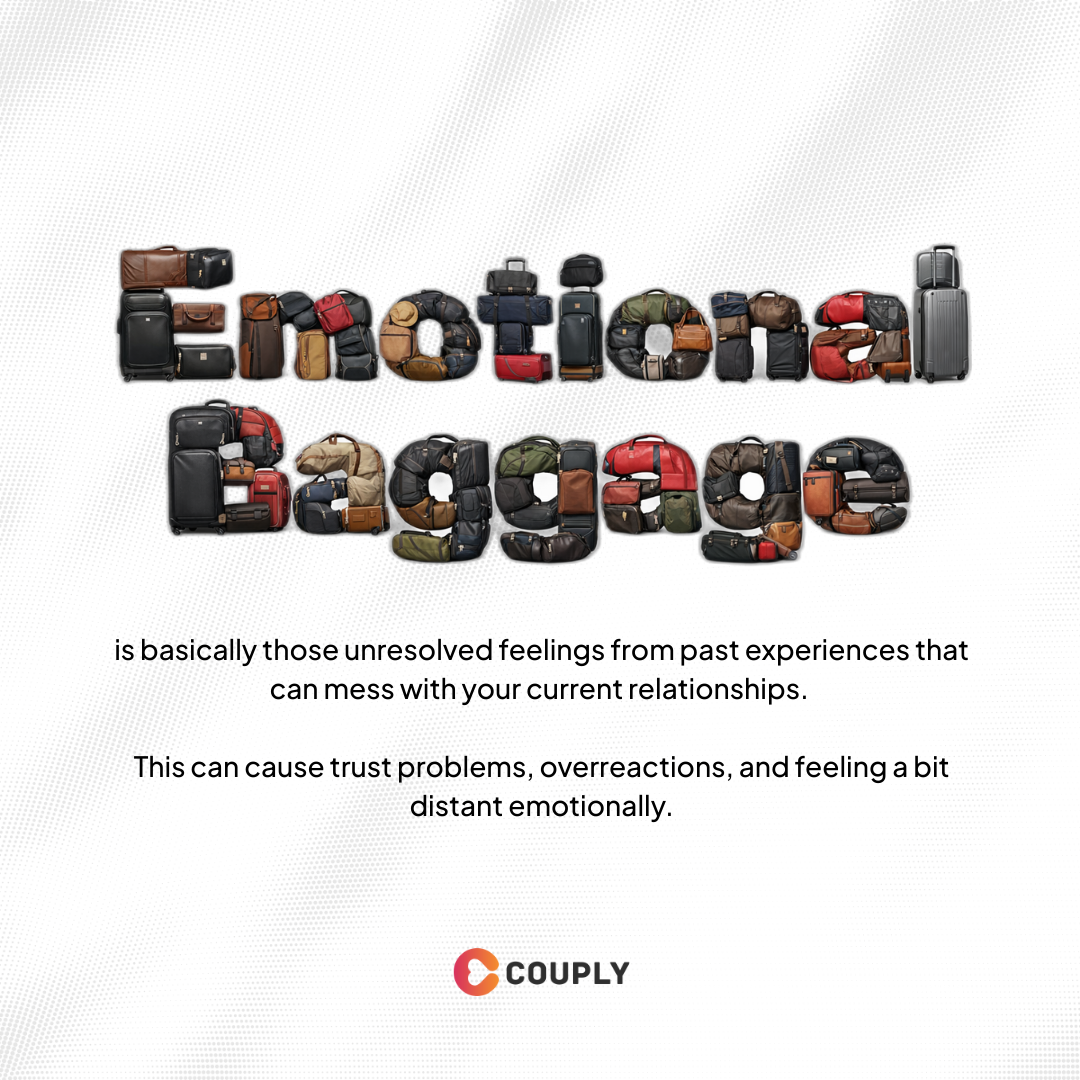
Basically, emotional baggage is unresolved emotional experiences or unprocessed experiences from past relationships. It includes experiences from every important relationship we’ve had, especially early ones with parents or caregivers. It can also stem from childhood wounds, trauma, betrayal, rejection, abandonment, criticism, emotional neglect, or inconsistent love.
READ: How Childhood Wounds Show Up in Adult Relationships
In simple terms, emotional baggage is what happens when painful experiences were never fully processed, understood, or healed.
What makes it tricky is that emotional baggage is often unconscious. We don’t usually walk into a relationship thinking, “I have abandonment wounds.” Instead, we notice patterns:
- We feel anxious when someone pulls away.
- We shut down during conflict.
- We expect to be disappointed.
- We overreact to small changes in tone or behavior.
Or worse, we may not realize those patterns until we reflect. We may not realize that our reactions are rooted in old experiences rather than the present moment.
Emotional baggage isn’t limited to long-term relationships either. Even if you’re just starting to date, you can still trip over old wounds. You might struggle to feel safe, feel hyper-alert to signs of rejection, or experience unexplained anxiety (even when nothing is objectively wrong).
This happens because the nervous system remembers what the mind tries to forget. Past pain gets stored not just as a memory but as a body-based response. So when something in the present resembles a past hurt, even slightly, your body reacts as if it’s happening all over again.
The work isn’t about blaming yourself for having emotional baggage; it’s about becoming aware of it so it stops running your relationships in the background.
How Emotional Baggage Sneaks Into Your Relationship
Emotional baggage rarely announces itself. It doesn’t say, “Hi, I’m your unresolved abandonment wound.”
Instead, it shows up quietly through reactions, assumptions, and patterns that feel very real in the moment.
Here are some of the most common ways it sneaks in:
1. Through Triggers
This is actually one of the biggest ways emotional baggage appears.
A trigger happens when something small in the present activates something painful or familiar from the past.
Suddenly:
- Small disagreements feel huge.
- A change in tone feels like rejection.
- A delayed reply feels like abandonment.
- Constructive feedback feels like deep criticism.
READ: Watch Out to These 9 Common Trauma Triggers in Relationships
You might notice your reaction feels bigger than the situation. That’s usually a clue.
For example:
Your partner says they need some alone time. Objectively, that’s healthy. But if you’ve experienced emotional neglect or abandonment before, your nervous system may interpret it as
“They’re pulling away.”
“They’re losing interest.”
“They’re going to leave.”
The present moment becomes filtered through past pain.
What’s happening is pattern recognition. Your brain is wired to protect you. If something even slightly resembles a previous hurt, your body reacts as if it’s happening again.
Your heart races.
Your chest tightens.
You feel anxious or defensive.
And before you realize it, you’re responding to yesterday’s wound instead of today’s reality.
That’s how emotional baggage quietly enters the relationship, not as logic, but as a felt sense of danger.
READ: How to Cope With Relationship Triggers
2. Through Assumptions
Another subtle way emotional baggage shows up is through the quiet beliefs we carry about relationships, especially the ones we don’t question.
These assumptions often sound like
- “All men are trash.”
- “Women can’t be trusted.”
- “If I’m not perfect, they’ll lose interest.”
- "If I don't perform, they'll leave me."
- “If I open up, I’ll get hurt.”
- “Love never lasts.”
These beliefs usually didn’t come out of nowhere. They were usually formed from experience. Maybe someone did leave. Maybe trust was broken. Maybe love felt conditional growing up.
Over time, your brain tries to make sense of the pain by creating a rule:
If I believe this, I can protect myself next time.
The problem is, these assumptions start operating in the background of new relationships. Instead of seeing your current partner for who they are, you may unconsciously filter them through old narratives.
For example:
- If you assume people always leave, you may become hyperaware of any sign of distance.
- If you believe you must be perfect to be loved, you may hide flaws or overperform.
- If you think vulnerability leads to betrayal, you may stay guarded.
These assumptions can become self-fulfilling. When we expect rejection, we may act in ways that create distance, pushing away the very connection we want.
The key thing to remember is this:
Assumptions feel like facts when they’re rooted in pain.
But they are interpretations shaped by past experiences and not guarantees about your present relationship.
3. Through Protective Behaviors
Sometimes emotional baggage doesn’t show up as fear, it shows up as protection.
When we’ve been hurt before, we develop strategies to make sure it doesn’t happen again. These strategies once helped us survive emotionally. The problem is, they can quietly sabotage healthy relationships.
Some common protective behaviors include:
Over-independence
“I don’t need anyone.”
You avoid relying on your partner. You minimize your needs. You pride yourself on handling everything alone.
On the surface, this looks strong. But underneath, it may be a fear of being disappointed, controlled, or abandoned.
People-pleasing
You say yes when you mean no.
You overextend.
You prioritize their comfort over your own needs.
This often comes from learning that love is earned by being easy, agreeable, or low-maintenance.
Testing your partner
You create subtle “tests” to see if they care enough.
You withdraw to see if they’ll chase.
You bring up hypothetical scenarios to gauge their loyalty.
These behaviors are usually rooted in insecurity — a need for reassurance that feels too vulnerable to ask for directly.
Emotional withdrawal
Instead of expressing hurt, you shut down.
Instead of arguing, you detach.
Instead of explaining what you feel, you say, “It’s fine.”
Withdrawal can feel safer than conflict, especially if past experiences taught you that expressing emotion leads to rejection or escalation.
The hard truth is this: protective behaviors protect you from intimacy as much as they protect you from pain.
They keep you safe but they also keep you distant.
And in healthy relationships, safety doesn’t come from guarding yourself. It comes from slowly learning that you don’t have to.
READ: 10 Subtle Ways You’re Punishing Your Partner Without Even Realizing It
4. Through Communication Patterns
Emotional baggage often reveals itself in how we communicate, especially during conflict.
When past wounds are activated, conversations stop being about the present issue and start becoming about protection.
Here’s how that can look:
Defensiveness
Instead of hearing feedback, you hear criticism. Instead of listening, you prepare your counterargument. Even neutral concerns can feel like personal attacks.
Defensiveness usually protects a deeper fear:
“If I’m wrong, I’m unlovable.”
“If I admit fault, I’ll be rejected.”
Stonewalling
You shut down completely.
You go quiet.
You disengage emotionally or physically.
Stonewalling is often a nervous system response. When conflict feels overwhelming or unsafe, the body goes into freeze mode. It’s not always intentional,sometimes it’s emotional overload.
Escalating Quickly
A small disagreement turns intense fast.
Your tone sharpens.
You bring up past issues.
You feel flooded with emotion.
When someone has unresolved hurt, their nervous system can react as if the relationship is under threat, even if the issue is minor. The reaction becomes bigger than the moment.
Avoiding Hard Conversations Entirely
You don’t bring things up.
You let resentment build.
You tell yourself, “It’s not a big deal,” when it actually is.
Avoidance often comes from fearing conflict, abandonment, or emotional chaos. If past experiences taught you that disagreements lead to disconnection, you may try to prevent them at all costs.
The pattern underneath all of this is the same:
Communication becomes about self-protection instead of connection.
And while these patterns once helped you cope, in a healthy relationship they can create distance, misunderstanding, and emotional exhaustion.
The Cost of Unchecked Emotional Baggage

Emotional baggage isn’t “bad.” It’s understandable. It developed for a reason.
But when it goes unexamined, it can quietly shape the relationship in ways that create distance, confusion, and exhaustion.
Here’s what often happens when emotional baggage runs unchecked:
1. Misunderstandings escalate.
Small issues turn into major conflicts because reactions are amplified by past wounds. What could have been a calm conversation becomes emotionally charged.
2. Healthy partners feel unfairly accused.
If you expect betrayal, abandonment, or criticism, you may interpret neutral behaviors as threats. Over time, your partner may feel like they’re constantly defending themselves against something they didn’t do.
3. Emotional intimacy decreases.
Protective behaviors such defensiveness, withdrawal, over-independence, slowly build walls. You may both still be physically present, but emotionally distant.
4. Cycles repeat.
The same arguments resurface. The same fears get triggered. The same endings happen. Without awareness, unresolved patterns tend to recreate familiar dynamics — even with different partners.
5. Relationship burnout sets in.
Constant hypervigilance is exhausting. So is feeling misunderstood. When both partners feel drained rather than safe, connection begins to erode.
Unchecked emotional baggage doesn’t just affect conflict, it affects safety. And without emotional safety, even a loving relationship can start to feel unstable.
The goal isn’t to eliminate your past. It’s to recognize when it’s influencing your present so you can respond consciously instead of reactively.
Signs Emotional Baggage Might Be Showing Up in Your Relationship

Emotional baggage doesn’t always look dramatic. Sometimes it shows up in subtle, repetitive patterns that feel justified in the moment but exhausting over time.
Here are some signs it might be influencing your relationship:
- You react more intensely than the situation warrants.
A small issue feels catastrophic. A minor disagreement feels like a threat to the entire relationship. - You struggle to trust, even without clear evidence.
You feel suspicious or guarded, even when your partner hasn’t given you a reason to doubt them. - You fear abandonment constantly.
You overanalyze tone changes, delayed replies, or shifts in routine as signs they’re pulling away. - You expect betrayal.
Even in good moments, there’s a quiet voice preparing for disappointment. - You self-sabotage when things are going well.
You pick fights, withdraw, test your partner, or create distance when intimacy starts to feel secure. - You replay old relationship narratives in your head.
“This always happens to me.”
“People eventually leave.”
“I knew it wouldn’t last.”
These patterns often feel protective, like you’re staying alert so you won’t get hurt again. But hypervigilance can quietly prevent you from experiencing safety in the present.
If you’re unsure whether emotional baggage is being activated, try pausing and asking yourself:
- “Is my reaction about now or about before?”
- “What does this situation remind me of?”
- “How old does this feeling feel?”
- “If I felt secure, how would I respond differently?”
Awareness doesn’t mean you’re doing something wrong. It means you’re beginning to separate past pain from present reality and that’s where real relational growth begins.
How to Unpack Your Emotional Baggage

Unpacking emotional baggage isn’t about becoming “perfect” or never getting triggered again. It’s about responding with awareness instead of reacting from old pain.
Here’s how to start:
1. Increase Self-Awareness Before Self-Blame
This is the most important step: awareness without shame.
Notice your patterns gently.
Notice your triggers.
Notice your reactions.
Instead of thinking, “Why am I like this?”
Try, “That reaction feels familiar. Where have I felt this before?”
Get curious. Be kind to yourself.
You can:
- Mentally note emotional spikes.
- Journal your triggers and what you felt in your body.
- Track recurring relationship themes.
Awareness is power — but only when it’s paired with compassion.
2. Separate Past From Present
When you feel activated, pause and reality-test.
Ask yourself:
- “Is my partner actually doing what I’m afraid of?”
- “What evidence do I have right now?”
- “Am I responding to today — or to history?”
Sometimes the fear is real. But sometimes the reaction is louder than the situation.
Learning to distinguish between the two is a huge part of emotional maturity and secure attachment.
3. Regulate Before You Communicate
When your nervous system is flooded, productive communication is almost impossible.
So pause.
- Take slow breaths.
- Ground yourself (notice 5 things you see, 4 you feel, 3 you hear).
- Step away briefly if needed.
- Name the emotion: “I feel anxious.” “I feel rejected.” “I feel scared.”
Naming the emotion reduces its intensity.
Regulation first. Conversation second.
4. Communicate Vulnerability Instead of Accusation
Emotional baggage often turns fear into accusation.
Instead of:
“You’re going to leave anyway.”
Try:
“When you don’t reply, I notice I feel anxious. I think it connects to past experiences.”
This shifts the focus from blame to ownership.
Vulnerability builds intimacy. Accusation builds defensiveness.
When you share the underlying fear instead of attacking the surface behavior, you invite connection instead of conflict.
5. Heal Individually
Some patterns require deeper work.
This may include:
- Therapy
- Attachment-focused work
- Trauma processing
- Developing self-soothing skills
- Rebuilding self-worth outside of the relationship
Your partner can support you — but they cannot heal wounds they didn’t create.
Individual healing strengthens relational health.
6. Invite Your Partner Into Growth
Once you understand your patterns, share them.
Not to make your partner responsible for fixing them — but to create awareness.
For example:
“I tend to get anxious when there’s distance. I’m working on it, but reassurance helps.”
Healthy relationships allow space for growth.
When both partners understand each other’s triggers and patterns, they can intentionally create new, corrective emotional experiences — ones that teach the nervous system that connection can be safe.
Unpacking emotional baggage isn’t about erasing your past. It means acknowledging that you do and of course, allowing yourself to grow beyond them.
Because the truth is, everyone carries something.
Just like a favorite quote of mine from the 23rd episode of the 5th season of the CBS sitcom How I Met Your Mother, "The Wedding Bride":
“Everyone has his baggage, it's part of life. But like everything else, it's easier when someone helps us.” ― Ted Mosby
And while healing is your responsibility, you don’t have to do it alone. In a healthy relationship, growth becomes collaborative. You unpack your past not because your partner demands perfection — but because you both deserve a relationship that isn’t constantly fighting old ghosts.
Sometimes, it really is easier when someone helps you carry it.
About the Author
.jpg)
Sheravi Mae Galang is a clinical psychologist and a content coordinator for the Couply app. Couply was created to help couples improve their relationships. Couply has over 300,000 words of relationship quizzes, questions, couples games, and date ideas and helps over 400,000 people.