


Some relationship issues are loud—fights, ultimatums, obvious disrespect. But the most damaging problems are often the quiet ones. The subtle shifts. The drained feeling you can’t explain. The way you slowly shrink without noticing it’s happening. These hidden signs can accumulate over months or years, quietly shaping a relationship that no longer supports who you are or who you’re becoming.
In this post, you’ll discover 12 less obvious but deeply meaningful signs that your relationship may no longer be supporting you. These aren’t the dramatic red flags everyone talks about—they’re the subtle emotional cues, behavioral patterns, and invisible shifts that often go unnoticed until you’re already overwhelmed. You’ll also learn what you can do next if any of these signs resonate with you.
What it means for a relationship to “stop serving you”
A relationship stops serving you when it takes more than it gives—emotionally, mentally, or even physically. Instead of feeling nourished, grounded, or understood, you feel depleted, anxious, or unseen. It’s not always about toxicity; sometimes it’s simply misalignment, burnout, or growing in different directions. But the result is the same: the relationship drains you more than it nurtures you.
12 Signs That Your Relationship is No Longer Healthy
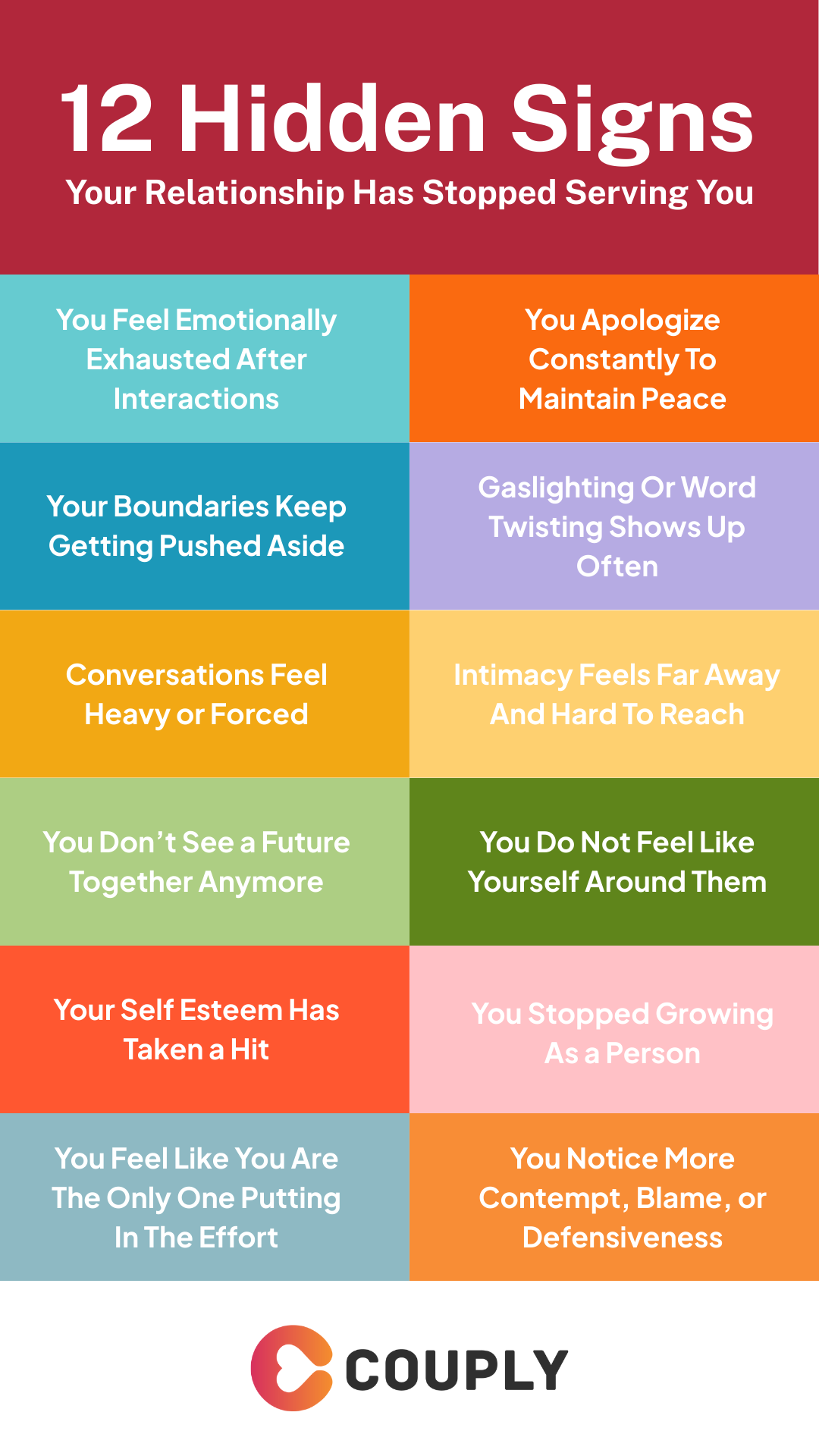
1. You Feel Emotionally Exhausted After Interactions
Ever leave a conversation with your partner and feel tired in a way that sleep cannot fix? Like your mind has been carrying a backpack full of rocks? That kind of exhaustion is usually a sign that something deeper is happening.
Here is what this often looks like:
- You do most of the listening while they do most of the talking.
- You support their stress, their fears, their drama, their everything, but your emotional stuff sits untouched.
- You catch yourself preparing for conversations because you know they might drain you.
- You feel lighter when you have time alone.
- You constantly try to be the emotionally stable one.
When emotional labor leans too heavily toward one person, the relationship slowly becomes unbalanced. One partner gives support while the other receives it, and over time that imbalance becomes exhausting.
Sometimes I tell clients that emotional exhaustion is like that moment when you finally sit down after carrying grocery bags that are way too heavy. You only realize how hard it was once you put them down. Relationships can feel like that too. You get used to holding everything, and you forget that it is not supposed to feel like a full time job.
And think about this for a second.
Do you feel more relaxed before or after interacting with them?
Your answer says a lot.
Feeling emotionally spent is not always dramatic, but it is meaningful. Healthy connection should bring comfort, not constant depletion.
2. You Apologize Constantly To Maintain Peace
If you are always the one saying sorry, pause for a moment and ask yourself why. Many people apologize to avoid tension. They want harmony. They want calm. They want the moment to pass without turning into something bigger.
But constant apologizing does not create peace. It creates pressure.
This often shows up in little ways:
- You say sorry even if you did nothing wrong.
- You apologize before sharing your feelings.
- You take the blame because it is faster than explaining what really happened.
- You feel responsible for their mood.
- You get anxious when you sense even a small shift in their tone.
In therapy, I sometimes hear someone say something like, I say sorry because it keeps things smooth. But when we look closer, we always find a pattern. The person learned to manage the relationship by shrinking themselves. It becomes a habit, like a reflex, and after a while they forget what it feels like to speak without fear of the reaction.
Let me ask you this.
Do your apologies make things better, or do they help you avoid something uncomfortable?
Constant apologizing also chips away at self esteem. After a while, you start believing you really are the problem. The irony is that the more you apologize, the smaller you feel. And the smaller you feel, the harder it becomes to communicate honestly.
Relationships thrive when both people take responsibility for their own emotions and behavior. If you always end up taking that role alone, it might be a sign that the relationship is no longer supporting you the way it should.
3. Your Boundaries Keep Getting Pushed Aside
You know that small pause you feel right before you say yes to something you actually don’t want to do? That tiny gut wobble? That is your boundary trying to speak. And when a relationship stops serving you, that feeling starts showing up a lot more often.
Here are a few signs this might be happening:
- You say yes when you want to say no.
- You feel guilty for wanting space or alone time.
- Your needs sound inconvenient, so you stay quiet.
- You adjust your schedule, comfort and even values to avoid conflict.
- You explain and re explain your limits but nothing changes.
A partner who cares will notice and respect your limits. They may not be perfect at it, but they will try. If instead you feel like you need to twist yourself into a version that is easier for them, the relationship slowly starts to work against you.
I’ve seen this so many times in sessions. Someone describes how they keep stretching themselves, and they say something like, "It is fine. I can handle it." But when we talk more, it turns out they have been handling things for so long that they no longer know what their real limit even feels like.
Ask yourself something simple.
Do your boundaries feel respected, or do they feel negotiable?
When you start believing your comfort is optional, that is a hidden sign the relationship is draining you more than supporting you. You deserve a space where your no is treated as a complete sentence.
4. Gaslighting Or Word Twisting Shows Up Often
Let’s keep this simple.
Gaslighting is when your reality keeps getting turned upside down. You remember something one way, they insist it happened another way, and somehow you end up confused about your own memory or feelings. Even subtle versions can make you doubt yourself.
Gaslighting does not always look dramatic. Sometimes it looks like this:
- They say you are being too sensitive when you express hurt.
- They downplay things that clearly bothered you.
- They twist past conversations to make you feel mixed up.
- They make you question if your reaction is valid.
- They act like your concerns came from nowhere.
Over time, this makes you second guess everything. You start thinking, Maybe I am overreacting. Or, Maybe I misunderstood. And the more you doubt yourself, the harder it becomes to speak up.
I have heard people describe this feeling as walking through fog. Things feel real in the moment, but then someone keeps telling you the fog is not actually there. After a while you stop trusting your own eyes.
Here is something important.
Healthy relationships do not make you question your sanity. They help you feel more sure of yourself, not less.
If your partner’s words consistently leave you confused, guilty or unsure whether your feelings are legitimate, that is a sign the relationship might be shifting into a place that no longer supports your well being.
5. Conversations Feel Heavy or Forced
You know that feeling when you are talking to someone and everything flows? You laugh. You share stories. You feel connected. Now compare that to when you talk to your partner and the conversation feels stiff or heavy. That shift is important.
Here is how this usually looks:
- Small talk feels easier than real talk.
- You start avoiding certain topics because they lead to tension.
- You feel like you need to rehearse what you want to say.
- You struggle to find anything meaningful to talk about.
- You feel relieved when the conversation ends.
When a relationship is no longer serving you, communication stops feeling natural. It becomes something you manage instead of something you enjoy.
The words are there. The spark is not.
Think about your last few conversations.
Did they help you feel closer, or did they leave you feeling flat?
When communication loses warmth, the relationship often loses its emotional anchor too.
6. Intimacy Feels Far Away And Hard To Reach
Intimacy is not only about physical closeness. It is also the soft moments. The inside jokes. The shared glances. The sense that you are on the same team.
When a relationship stops serving you, that closeness slowly fades. Not always in dramatic ways. Sometimes it is quiet, like a dimmer switch turning down little by little.
This often shows up in ways like:
- Less affection or touch.
- Less honest sharing about feelings.
- Fewer moments of vulnerability.
- Less interest in each other's inner world.
- You feel like roommates instead of partners.
People sometimes describe it as living in the same house but feeling miles apart. You still do the everyday stuff. You still exist side by side. But the emotional connection feels thin.
I once had someone say, We sit next to each other, but I miss them. That line stayed with me, because it captures this feeling perfectly.
Let me ask you.
Do you still feel seen and understood by them?
Or do you feel like there is a quiet distance growing between you?
Intimacy should feel safe and accessible. When it feels hard to reach, it might be a sign the relationship is drifting into a place that no longer nurtures you.
7. You Don’t See a Future Together Anymore
There comes a point when you stop imagining a shared future, and you may not even notice it right away. It can be subtle. You stop saying things like next year or when we travel or when we move. You start thinking more in terms of me instead of we.
This often shows up in different ways:
- You feel unsure saying long term plans out loud.
- You avoid conversations about the future because they feel heavy.
- You picture your life in a few years, and they are not really in that picture.
- You stop dreaming together or planning anything meaningful.
- You feel disconnected from the idea of growing together.
Let me ask you something simple.
When you imagine your happiest future, who is standing next to you?
If the answer is unclear or feels off, that is a quiet sign that the relationship may not be supporting your growth anymore. A connection that serves you will help you imagine possibilities, not avoid them.
8. You Do Not Feel Like Yourself Around Them
This one hurts a little, because it happens so slowly. You start changing tiny parts of yourself without noticing. You talk less. You hold back jokes. You play it safe with your opinions. You shrink your personality because something about being fully yourself does not feel comfortable around them.
You might notice:
- You filter what you say to avoid reactions.
- You feel like you walk on eggshells.
- You hide parts of your personality that used to feel natural.
- You act more careful or controlled than you do with others.
- You miss the version of yourself who felt free.
I have heard people describe this as losing their spark. And honestly, that is exactly what it feels like. Your energy dims. Your confidence softens. You start molding yourself to fit the relationship instead of feeling supported to be exactly who you are.
I remember someone once saying, I feel like I leave myself at the door when I am with them. And that line hits deep, because when you lose pieces of yourself in a relationship, you eventually lose joy too.
So think about this.
Do you feel larger or smaller when you are with them?
A relationship that truly serves you helps you feel more like yourself, not less.
9. Your Self Esteem Has Taken a Hit
One of the quietest signs that a relationship has stopped supporting you is when you stop feeling good about yourself. It does not always come from direct criticism. Sometimes it is the environment. The vibe. The weight of the dynamic. You slowly stop feeling confident or valued, and you may not even notice when it started.
Here is how it often shows up:
- You doubt yourself more than you used to.
- You feel nervous sharing your opinions.
- You get scared you might say the wrong thing.
- You feel judged or misunderstood.
- You no longer feel attractive or interesting.
Over time, this can really shape the way you see yourself. I have seen clients go from feeling bold and expressive to timid and unsure, all because the relationship slowly chipped away at their confidence.
So think about it.
Do you feel better about yourself when you are with them, or do you feel more insecure?
A partner who supports you will help you feel grounded and confident. Not drained. Not unsure. Not suddenly questioning everything about yourself.
10. You Stopped Growing As a Person
Growth is a big sign of a healthy relationship. You feel inspired. You evolve. You move toward your goals. But when a relationship stops serving you, your personal growth slows down or even comes to a full stop.
This can show up in subtle ways:
- You lose interest in things you used to love.
- You stop working on personal goals.
- You feel stuck or stagnant.
- You stop challenging yourself.
- You spend more time managing the relationship than improving your life.
Sometimes people stop growing because the relationship takes up too much emotional space. There is no energy left for hobbies, learning, creativity, or future plans. Everything feels paused.
Ask yourself this.
Are you becoming the person you want to be in this relationship?
If the answer is no, that is a meaningful sign. A supportive relationship helps you grow, encourages your goals, and gives you room to become your best self.
11. You Feel Like You Are The Only One Putting In The Effort
One of the clearest signs a relationship has stopped supporting you is when the effort no longer feels mutual. You start noticing that you are the one carrying the emotional weight, doing the planning, fixing the issues, and keeping everything afloat. And even if you do not say it out loud, the imbalance slowly wears you down.
Here are the small things that usually show up:
- You are always the one reaching out or initiating conversations.
- You plan the dates, the schedules, and the important moments.
- You bring up issues because they never do.
- You notice patterns that need to change, but they seem comfortable staying the same.
- You put in the work to keep the relationship strong, while they ride the flow.
Let me ask you something real.
If you stopped trying, would the relationship feel different?
Or would it fall apart?
That one question usually reveals a lot.
When effort is one sided, burnout eventually happens. You start feeling lonely even though you are not technically alone. A relationship that serves you should feel like a partnership. Two people showing up. Two people caring. Two people trying.
Effort should feel shared, not lopsided.
12. You Notice More Contempt, Blame, or Defensiveness
This one is a big emotional indicator. Contempt and blame are like relationship termites. They slowly eat away at connection, trust, and respect. And the tricky part is that they often show up in very small moments before they grow into bigger problems.
You might notice things like:
- Sarcasm that feels mean instead of playful.
- Eye rolls or annoyed sighs that sting a little.
- Blame shifting even when you try to express something gently.
- Defensiveness when you bring up even simple concerns.
- Feeling like everything turns into an argument.
These behaviors create a cycle. You share a feeling, they get defensive. You notice something hurtful, they blame you instead. After a while, you stop bringing things up altogether because you already know how it will go.
Think about your last few disagreements.
Did you feel understood, or did you feel attacked?
Healthy relationships are not perfect, but they involve curiosity, not contempt. They involve responsibility, not constant blame. When the emotional tone shifts into irritation or dismissal, it is a sign the relationship may no longer be a safe place for connection.
Here’s a polished, cohesive version that matches the tone of the earlier signs—clear, supportive, and reader-friendly:
What to Do If You Recognize These Signs
1. Self-Reflection & Journaling
Start by turning inward.
Ask yourself:
- Which of these signs show up most often in my relationship?
- How do they affect my mood, energy, and sense of self?
Writing your thoughts down helps you see patterns you may have been overlooking.
2. Open a Conversation (If It Feels Safe)
If you feel comfortable doing so, gently bring up what you’ve noticed.
Use simple, non-blaming statements like:
- “I feel overwhelmed when…”
- “I’ve been noticing a pattern, and I want us to talk about it…”
Focus on specific behaviors—not character judgments—to keep the conversation grounded and respectful.
3. Seek Support
You don’t have to sort this out alone.
Support options include:
- Individual therapy
- Couples counseling
- Confiding in trusted friends or family
Sometimes an outside perspective brings clarity you can't get on your own.
4. Set (or Reassert) Boundaries
Clarify what you need to feel safe, valued, and respected.
Be clear and direct:
- “I need more transparency around…”
- “I’m not comfortable with…”
Healthy boundaries protect your emotional well-being and create room for healthier interactions.
5. Decide What’s Next
Once you understand the full picture, consider your next step:
- Can the relationship grow with effort from both sides?
- Do you need space or a temporary break?
- Or is it time to step away for your own peace?
There’s no “right” choice—only the choice that aligns with your long-term well-being.
These twelve hidden signs aren’t just red flags—they’re signals that your relationship may be draining you more than it’s nourishing you.
Recognizing them is brave. Acting on them is even braver.
If this resonated with you:
- Reflect.
- Journal.
- Reach out for support.
And consider sharing this with someone who might need the reminder that their feelings matter, too.


